Is Georgia a no fault state for car accidents? No. Georgia generally uses an at-fault system. Who caused the crash matters when an injured person seeks compensation from someone else. The facts, the insurance, and the law still shape the result. The label alone does not decide a claim. The firm's Atlanta personal injury services include help for people hurt in car and truck crashes.
You can request a free, no-obligation case review or call (404) 627-2811. A short conversation can help you sort out what to gather next.
Is Georgia a no fault state for car accidents under an at-fault system?
In a no-fault system, some injury claims start with a person's own insurance. That can happen even when someone else caused the crash. Georgia is not generally described that way. Responsibility for the crash is central when someone seeks injury compensation from another party.
Fault is not always obvious. An insurer does not have to accept responsibility on the first call. Drivers may tell different stories. Photos may be incomplete. More than one factor can play a part. An insurer may look at how the crash happened, which coverage applies, and which losses are claimed.
Georgia law also recognizes that responsibility can be shared. O.C.G.A. § 51-12-33 is the provision that covers this. Under subsection (a), if a plaintiff shares some fault, the fact finder assigns that percentage and the judge reduces the damages in proportion. Under subsection (g), a plaintiff who is 50 percent or more responsible is not entitled to receive any damages. How those rules apply depends on the facts. You can read the current text on Georgia Commons' copy of O.C.G.A. § 51-12-33. This article is general information, not legal advice about a specific crash.
Is Georgia a no fault state for car accidents, and how is insurance different?
The practical difference is which question comes first. In a no-fault framework, a person's own coverage may be the first route for certain injury benefits. That can happen before anyone decides who caused the crash. In Georgia's at-fault framework, a claim against another party generally depends on evidence of that party's responsibility. Coverage and the losses still matter too.
Neither description means every bill is paid right away. A policy does not cover every loss. Insurance follows the policy's terms, limits, exclusions, and notice rules. Calling your own insurer to report a crash is not the same as deciding who was legally responsible.
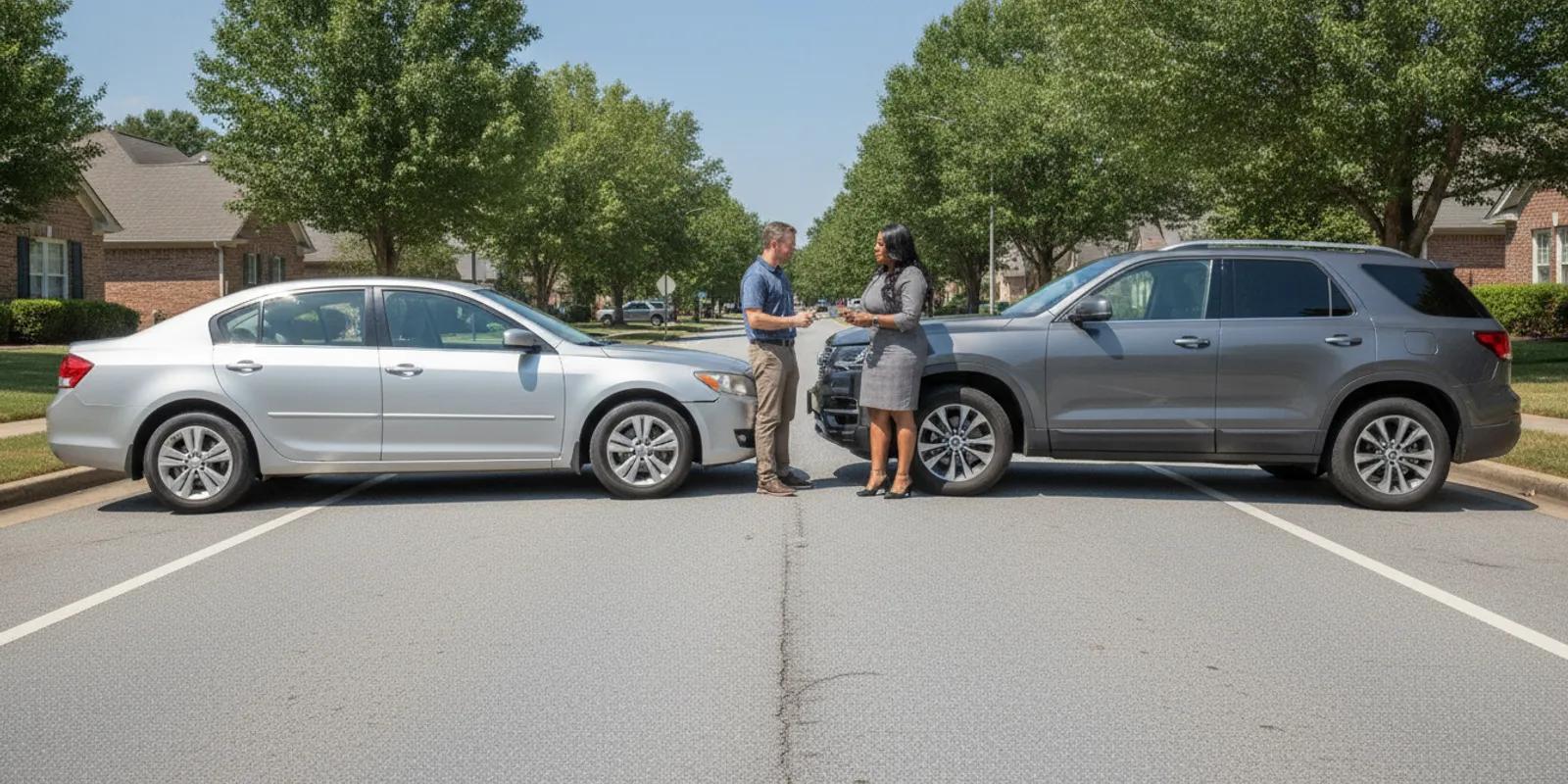
Take a rear-end collision as an example. The drivers may agree on the point of impact. They may still disagree about what happened just before it. A review may look at each account, photographs, vehicle damage, witness information, and other records. The example shows why evidence matters in an at-fault system. It does not predict the outcome of any claim.
Which insurance path might be involved after a Georgia crash?
There may be more than one insurance conversation after a crash. You may need to notify your own insurer because the policy requires it. You may also pursue a claim with another driver's insurer. If several vehicles or another party may be responsible, more coverage may need to be identified. Which path applies depends on the facts and the policies.
Georgia's Office of the Commissioner of Insurance and Safety Fire explains the basic auto coverages on its auto insurance resource page. Liability coverage is required to drive on public roads. The stated minimums are $25,000 per person and $50,000 per incident for bodily injury, plus $25,000 per incident for property damage. Collision and comprehensive coverage for your own vehicle are not required by state law, though a lender may require them. Uninsured motorist coverage is a separate topic if the other driver has no insurance. Those figures are general state minimums, not a statement of what any one policy pays.
| Path. | Focus. | Gather. |
|---|---|---|
| Other party. | Fault. | Photos. |
| Your insurer. | Notice. | Policy. |
| Several parties. | Each role. | Names. |
Read the three rows this way. A claim against another party focuses on fault and on whether coverage responds. Gather photos, names, and records. A call to your own insurer focuses on notice rules and on your policy. Gather the policy, the claim number, and receipts. A crash with several possible parties focuses on each role and each policy. Gather names, vehicle details, and witness contacts.
This table is a general comparison, not a coverage decision. Read the policy. Ask the insurer to explain any notice or document request that is unclear. Write down the person you spoke with, the date, and any claim number.
What evidence can help explain how a crash happened?
Details get harder to recall with time. If it is safe, make a record of what you can. Do not put yourself at risk. Do not delay urgent medical care to collect information.
- Scene details: date, approximate time, location, travel direction, weather, lighting, and road conditions.
- People and vehicles: names and contacts for drivers, passengers, and witnesses, plus vehicle descriptions and insurance information.
- Photographs: vehicle positions, damage, traffic controls, road markings, debris, and visible injuries, taken only from a safe place.
- Incident records: crash-report details, the responding agency, and any report number.
- Injury and loss records: medical visit dates, treatment paperwork, receipts, and notes about other losses tied to the collision.
- Communications: insurer letters, emails, claim numbers, and notes of calls or requests.
Keep original photo files when you can. Note when and where they were taken. Do not edit an image in a way that removes context. Store copies together, and keep originals in a safe place. If a record is missing, write down what you remember and where it might be requested.
What practical steps can you take after a collision?
Start with safety and medical needs. Follow emergency responders' instructions. Get care for injuries or symptoms that worry you. Evidence comes second to immediate care.
- Address immediate danger. Move to a safer place if you can do so without adding risk. Call emergency services when needed.
- Exchange and record information. Note the other driver's name, contact details, vehicle information, and insurer. Ask witnesses for contact information if they are willing.
- Document only when safe. Photograph the scene and note the location and conditions. Do not stand in traffic. Do not approach an unsafe vehicle for a picture.
- Notify insurers as required. Check your policy and tell your insurer what the reporting rules require. Keep copies of what you send and receive.
- Make a timeline. Write what you recall. Note who you spoke with, when, and what follow-up was requested.
- Organize injury-related records. Keep appointment information, medical paperwork, and receipts in one folder. Do not delay care to build a file.
For more on documenting the scene, read what to do after a car accident in Atlanta. A related Georgia crash next-steps guide covers the same early window from a statewide angle.
How can shared responsibility affect a Georgia car accident claim?
When more than one person may have contributed, responsibility is often disputed. O.C.G.A. § 51-12-33 can reduce damages in proportion to a claimant's share of fault. The same section bars damages when that share is 50 percent or more. A short account of a crash is not enough to apply those rules.
Consider a hypothetical intersection collision. One driver says the other entered against the signal. The other says the first driver was speeding. A witness may remember only part of the sequence. Photographs may show where the vehicles stopped, not which light was green. Keep statements, observations, and confirmed evidence in separate notes.
Early labels such as "rear-ended" or "failed to yield" do not answer every question. Timing, visibility, the road layout, and the accounts of people who were there can all matter. Do not guess about details you cannot recall. If you later correct your own account, note what prompted the update.
Is Georgia a no fault state for car accidents when insurance is limited?
That question turns to your own policy. Some policies include uninsured or underinsured motorist coverage. Some do not. Do not assume a benefit exists or that it will pay a particular loss. Read the policy and ask the insurer what notice it expects.
When several vehicles or a commercial vehicle are involved, finding every relevant policy can take more work. The same personal injury services overview describes representation in motor vehicle and truck matters. A related guide explains who may pay medical bills after a Georgia car accident.
How can you keep claim information organized?
A simple system keeps details from scattering across texts, email, and paper. Make one folder for the collision. Use a short index so you can see what is inside. Separate documents by type so you are not searching the whole file each time.
- Timeline: date and time of the collision, calls, letters, appointments, and follow-up tasks.
- People: names, roles, contact information, and the date you spoke with each person.
- Insurance: policy details you have, claim references, requests, and responses.
- Medical and expense records: appointment dates, documents received, and receipts.
- Evidence: photographs, witness information, and incident-report details, with originals preserved.
If an insurer asks for a document, record the request date, the item, and how you responded. If you do not understand a request, ask for a clearer explanation. Organization does not decide fault. It does make later conversations more accurate.
What should you prepare before discussing the process?
You do not need a perfect file before you ask questions. Gather what is easy to find: a short timeline, contact details, photographs, insurer letters, and records of medical visits. Note what is still uncertain or missing.
Write down the questions you want answered. You might ask which records could help explain the events. You might ask how insurer calls are usually handled. You might ask whether any deadlines may apply. A conversation can clarify what is useful. It is not a substitute for the actual documents.
The Law Office of Laquetta S. Pearson represents people injured in motor vehicle matters in the Atlanta area. Laquetta S. Pearson has 23 years of experience practicing Georgia law, and the firm's attorneys have a combined 43 years of experience. You can read about the firm's background and approach and its Atlanta personal injury FAQ.
Deadlines are a separate question. The firm's Georgia car accident deadline guide explains the timeframe issue. Deadlines can depend on the claim, so do not use a general article to calculate yours. The firm has reported recovering millions of dollars for clients. That history is not a promise about any future result.
If you were hurt in a Georgia crash and want help understanding the next step, request a free, no-obligation case review or call (404) 627-2811.
Frequently Asked Questions
Is Georgia a no-fault state for car accidents?
No. Georgia generally follows an at-fault approach. Who caused the crash matters in an injury claim. Insurance and the specific facts still matter too.
Does the other driver's insurer have to pay automatically?
No. The insurer may review responsibility, policy coverage, and the claimed losses. A dispute can arise over any of those questions.
Can I recover if I was partly responsible?
Possibly, if your share of fault is under 50 percent. O.C.G.A. § 51-12-33 can reduce damages in proportion to that share. If the share is 50 percent or more, the statute says the plaintiff is not entitled to damages. A general description cannot resolve one crash.
Should I contact my own insurer?
Review your policy for reporting rules and contact your insurer about the notice it expects. Reporting a crash does not by itself decide fault or prove coverage.
What should I save after a crash?
Keep photographs, driver and witness details, insurance information, incident records, insurer letters, and records related to care and other losses. Store copies where you can find them later.
Georgia's at-fault framework makes responsibility and insurance relevant. Neither can be decided from a headline or a single account of a crash. Put safety first, keep the records you have, and get clear answers about your own circumstances. If a question about coverage or shared fault is still open, write it down before you call. A clear question is easier to answer than a long retelling of the crash.